I am going to look at the off hours for you IBFs next week. And post comments in other forum.
You are the first person I have heard of doing a strangle AND an IBF into news. Interesting train of thought there!
I will check back with more stats on strangles as the week moves on…and hopefully some ideas on how to get the risk down on this trade. Like I said…with such a high probability if I can get that part of the equation to fit…its a good money maker!
[quote=chazw661]I am going to look at the off hours for you IBFs next week. And post comments in other forum.
You are the first person I have heard of doing a strangle AND an IBF into news. Interesting train of thought there!
I will check back with more stats on strangles as the week moves on…and hopefully some ideas on how to get the risk down on this trade. Like I said…with such a high probability if I can get that part of the equation to fit…its a good money maker!
I have been doing the long term strangles on EURUSD as well from between 9 to 11pm the previous day for an 11 am expiry. I had 8 wins out of 9 trades the last two weeks. I bought on average about $20 risk on each sides and took profit 1:1. Seems a very good strategy because you let the market do its thing over the European and US open as well as any news that may come up in between. You have to trust the market to be unpredictable like it usually is. One thing I have found is peace of mind and less stress to be watching every tick and making directional trades. Moreso, the risk is bearable. One thing though is that Creek’s model of buying dirt cheap and taking $20 profits appears better than what I have been doing because in my system if you lose on both sides, you need to wins to make it back. Hence, I would try Creek’s model going forward. One sure thing is this system preserves capital and is consistent as long as you see those strikes inside the expected range hi to lo. They are even better when you get them near the close to close for a little more risk ($23). One thing I also did was buy two strikes say $14 and $24 to see whether the higher risk is better in case both strikes do not move at the same pace. What I found is both were always winners as long as you took profit 1:1.
hello, I just recently joined Apex and have been watching the various videos about strategies. I was about to giving up on trading because trying to watch every candle and pick a direction is stressful unless there is a strong trend. I tried out a couple of IBFs last week on a demo account on forex just after 6pm during the quiet time of markets and I won on both. I like the idea of volatility trading vs directional…
I recently just found this thread and am pretty excited about it. Are you still doing these? I see there hasn’t been an update in about a month or so, so wasn’t sure. When doing these, is there a certain strike that you are looking for or is it a far OTM strike that is dirt cheap? I didn’t really understand your rules on your first post about the close to close ranges but this strategy seems easy enough and will be testing this week if you respond in time. And lastly, on Jan 16 you posted the graph, shown above, why some days did you do two of them? Were the setups better. Just trying to understand fully before I start. Hope to hear back
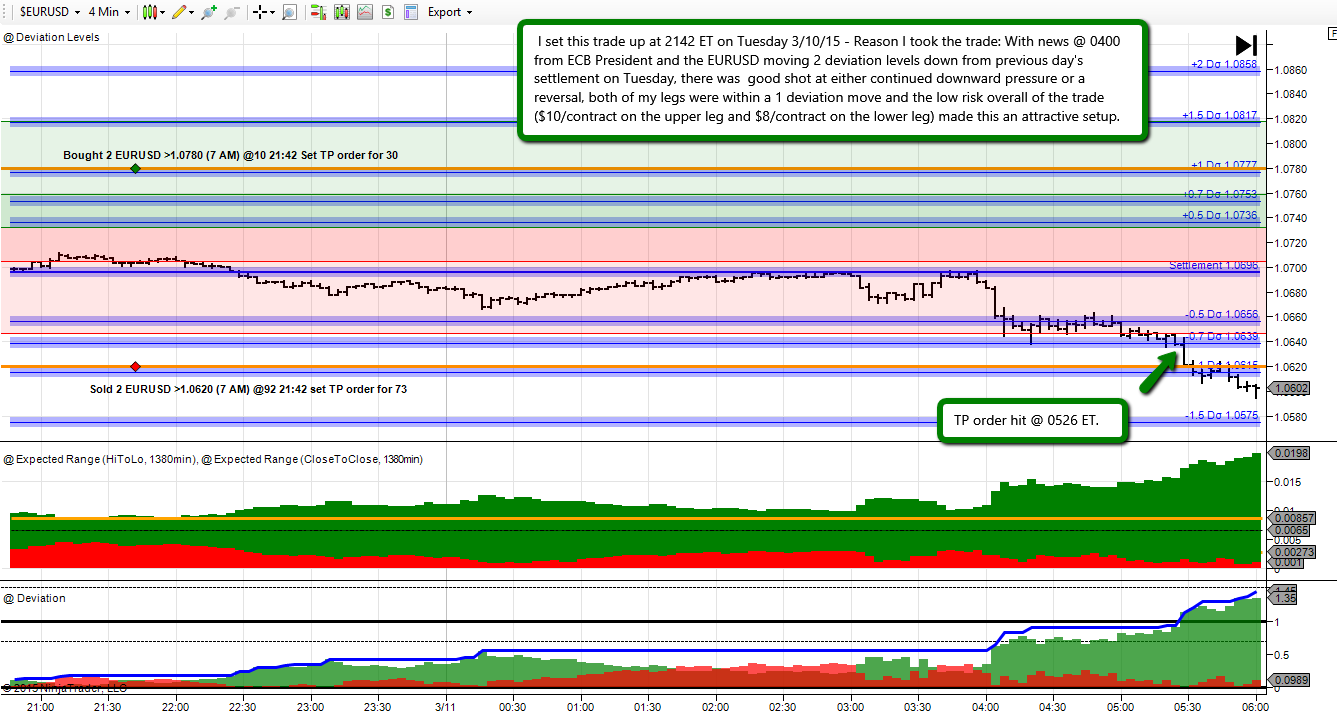
Here is a successful overnight strangle on EURUSD. I marked up the chart with the reasons I took the trade and where I entered and set TP and where it settled. Your posts have been extremely helpful and I thought I would share my first success here with you.
Hello everybody,
I am kind of new and trying to learn more about Strangles. Would anyone be kind enough to answer my question, please?
In a case that either your are busy doing something or you want to leave your trades and go to bed;
How you determine at what Indicative Market Price your Stop Trigger has to be set to cover your costs and fees with little margin?
In another words, How you determine what your " Trigger Price" should be?
Great question. Because of the low risk nature of a strangle (you are buying an OTM Binary) you generally do not need a stop. You set it and forget it.
I posted this example a while back, each contract only cost me $8/$10 so if it didn’t work then my max loss was $18. I did set myself a pretty low TP it looks like (was still relatively new to this all) but now I would probably set my TP around $85.
timelord914,
thank you very much for your fast response. I am not worry about loss, I am worry for the exit at the right time when the contract reaches a good level which we have to exit to take the profit. I am afraid, if i leave it, one of the contract get to a good level and before i exit, go back down and both BUY & SELL become loss.
what would you suggest?
thanks a million,
Ideally you could go for a 1:1 based on implied volatility etc. so if you spend a total of $20 between the two contracts you would want to take profit at your strike price + $20 on a buy or take profit at your strike price -$20 on a sell.
You could also set take profit at $85 on a buy or $15 on a sell, just know that this is a lower probability trade than going for 1:1.
The options are really limitless, each trade should be evaluated on it’s own merits and you set your TP based on your analysis. There is a great tool in the APEX toolkit called expected time indicator that will show how long it will take to hit a certain price and that is a great tool to use when evaluating strangles.